

Plant-based Alternatives Market Size to Exceed USD 75.64 Billion by 2034 | Towards FnB
According to Towards FnB, the global plant-based alternatives market size is calculated at USD 33.42 billion in 2025 and is anticipated to surge USD 75.64 billion by 2034, reflecting at a CAGR of 9.5% from 2025 to 2034. The rapid growth of the plant-based alternatives market is largely attributed to shifting consumer attitudes towards food sustainability and ethical eating.
Ottawa, Dec. 05, 2025 (GLOBE NEWSWIRE) -- The global plant-based alternatives market size stood at USD 30.52 billion in 2024 and is predicted to increase from USD 33.42 billion in 2025 to reach around USD 75.64 billion by 2034, according to a report published by Towards FnB, a sister firm of Precedence Research.
The growth for this industry is being driven by the integration of environmental alertness, health issues and ethical considerations. Users are finding healthier selections to lower the usage of red and processed meats and avoid animal cruelty.
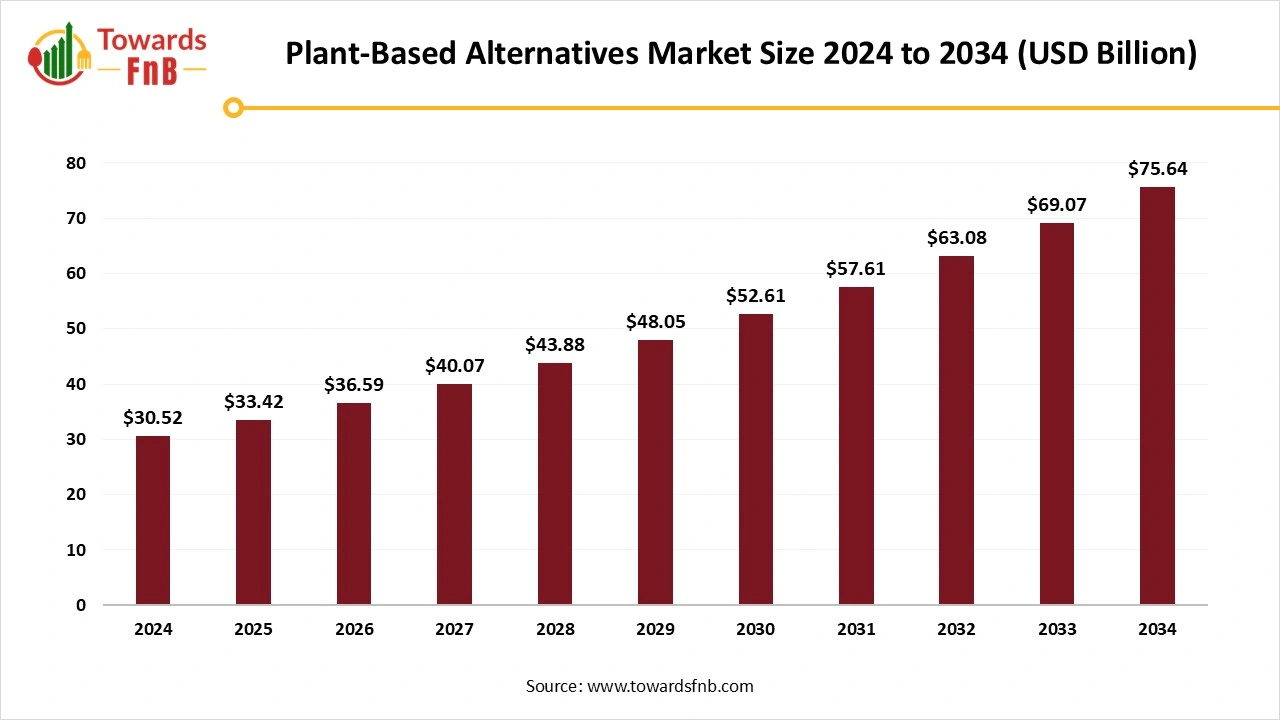
Note: This report is readily available for immediate delivery. We can review it with you in a meeting to ensure data reliability and quality for decision-making.
Access the Full Study Instantly | Download Sample Pages of the Report Now@ https://www.towardsfnb.com/download-sample/5932
Plant-based Alternatives Market Key Highlights
- By region, Asia Pacific dominated the global market with the largest share in 2024.
- By region, North America is projected to experience a notable CAGR from 2025 to 2034.
- By type, the dairy alternatives segment held the largest market share in 2024.
- By type, the meat alternatives segment is expected to grow at a strong CAGR between 2025 and 2034.
- By source, the soy segment contributed the highest market share in 2024.
- By source, the almond segment is forecasted to expand at a significant CAGR from 2025 to 2034.
- By distribution channel, supermarkets and hypermarkets led the market in 2024.
- By distribution channel, the online stores segment is anticipated to grow at a significant CAGR over the forecasted period.
Plant-based Alternatives Market Outlook & Insights
Plant-based alternatives are the foods created from plant-derived elements that copies the texture, taste and look of regular animal products like as dairy, meat and eggs. They are generated to substitute the usage of animal sourced items and can range from less processed whole foods to more formulated commercial products.
The plant protein which are minimally processed are peas, lentils or soy. Outcome better nutrition and environmentally in the research. So, minimising the processing of ingredients and developing nutritional criteria should be given high importance while buying or purchasing new products.
Major Importers of the Plant-Based Alternative Products:
- Worldwide, the leading three importers of Plant based Alternatives are Uzbekistan, Colombia and United States. Colombia has topped the globe in plant-based alternatives imports with a 38 shipments, which is being filled by Uzbekistan with a 16 shipments and United States has taken the third spot with a total number of 8 shipments.
- The globe mostly imports its Plant Based Alternatives from Sweden, Israel and China too.
- As per the worldwide data, the globe has imported 56 shipments of the Plant Based Alternatives during a period May 2024 to April 2025. These importers were being officially supplied by 16 exporters to 19 Global buyers that marks a growth rate of 211% as compared to the leading twelve months.
- At this period, in April 2025, the world has alone imported 5 plant based alternatives shipments.
View Full Market Intelligence@ https://www.towardsfnb.com/insights/plant-based-alternatives-market
New Trends in the Plant-Based Alternatives Market:
- Importance on price, taste and Convenience: Users are more selective other than the starting demand and give importance to price, taste and easiness over novelty. In order to drive repat purchases, organizations should invest in research and development in order to improve sensor qualities and search ways to serve more competitive pricing.
- Movement towards a whole-food ingredients and cleaner label: Consumers are still questioning the health standards of heavily processed plant-based items. Companies are giving feedback by giving importance to transparent “clean” labels and by using the more whole-food ingredients like mushrooms, legumes and fruits.
- Growth of private Labels: In feedback to development, the growth of private-label, or store-company, the plant-based products has developed across several markets by serving more reliable options.
- Advanced Technologies: Novel technologies are being utilised to develop products. These count 3D printing for the actual texture, accuracy fermentation to make proteins for a meat-like flavor and developing fungi for a fibrous texture.
- Innovative Formats: The sector is developing beyond just sausages and burgers. Inventions count whole-cut alterations like chicken breasts and steaks, in addition with items that are crafted for particular cuisines.
- Focus on re-engaging lapsed consumers: The sector selects a demand to win back users who have lastly tried plant-based products but where it is left is being unsatisfied by price or taste. It develops the product quality and lessens costs which is important for re-engagement.
Impact of AI on the Plant-Based Alternatives Market
Artificial intelligence is reshaping the plant-based alternatives market by improving ingredient selection, refining texture and flavor development, and strengthening operational efficiency across the value chain. One major shift comes from AI-driven formulation tools that evaluate thousands of plant proteins, fats, and fibers to identify combinations that best replicate the functional properties of meat, dairy, and egg products. These systems analyze solubility, emulsification behavior, heat stability, and amino acid balance, allowing developers to fine-tune products without long cycles of physical testing. As a result, plant-based burgers, cheeses, milks, and yogurts can achieve more realistic textures and more stable nutritional profiles.
Flavor development has also become more targeted. Machine learning models map plant-based ingredients to specific sensory attributes, helping key players identify which compounds create metallic or beany notes and how to neutralize them. This approach supports cleaner labels by reducing reliance on masking agents and unnecessary additives.
AI also optimizes extrusion conditions, fermentation parameters, and homogenization processes. Real-time sensors track moisture, viscosity, and particle size, while predictive analytics adjust equipment settings to maintain batch consistency. This reduces waste and improves the scalability of plant-based manufacturing lines.
Recent Developments in the Plant-Based Alternatives Market
- In January 2025, Project Eaden raised USD15.6, m Series A in order to reveal “ultra -realistic" plant-based meat by using the fiber spinning technology. This company is a Berlin-based startup that includes fiber compounding and spinning technology to make “ulytra-realistic” meat alternatives.
- In June 2025, Country Delight revealed the launch of its all -latest Oats Beverage which marked its incursion into the fastly developing plant-based drink segment. It is crafted for the health -conscious users finding a nutritious and reliable alternative.
- Boermarke B.V ,is one of the top European partners for the plant-based yogurt,cheese and the ice-cream manufacturing for the foodservice and retail sectors who has revealed an series of dairy alternative drinks ,yoghurts and the pushing named an Pure-Pak Sense Cartons that has Natural Brown Board.
- In June 2025, Plant-based developed named Meala FoodTech Ltd has collaborated with the dsm-firmenich in order to reveal Verstis “PB Pea -an innovative texturizing pea protein which is single and multifunctional ingredient that is crafted to substitute updated binders like as hydrocolloids.
- In August 2025, An italian food company is perfect in organic plant-based beverages by named The Bridge has revealed two latest products at main retailers under its ViaMia Brand.
- In November 2025, Planteneers has disclosed an latest line of plant-based cheese alternatives which is crafted to align with rising urge for the products that integrates bot nutritional and sensory appeal advantages.
- In November 2025, Danone has revealed the launch of the SilkProtein which is an series of plant -based milks that ahs 13 kg of overlap protein and the 3Kg of fibre per serving.
Top Products Categories in Plant-based Alternatives Market:
| Product Categories | Branded Product | Primary plant-protein Ingredient | Secondary Ingredient | Major markets with ingredient confirmed product availability |
| Sausages | Quorn | Mycoprotein | Rapeseed, palm oil | U.S., UK, Ireland, France, Italy |
| Plant-based milk alternative | Alpro or Almond-based drink | Water | Almond | UK, Ireland, France, Italy |
| Meatballs | Future Farm | Chickpea | Coconut oil | US, Canada, UK, France, Italy, Brazil |
| Burgers | Beyond Burger | Pea | Rapeseed, coconut oil | US, Canada, UK, France, Italy |
| Minimally processed | n/a | Soy, chickpea, pea, lentil, | n/a | |
| Chicken | Vegetarian Butcher | Soy | n/a | US, Canada, UK, Ireland, France, Italy, Brazil |
For Detailed Pricing and Tailored Market Report Options, Click Here: https://www.towardsfnb.com/checkout/5932
Role of Latest Technologies in the Plant-Based Alternatives Market
-
AI-Driven Formulation
- Uses machine learning to design better textures, flavors, and nutrient profiles.
- Helps shorten R&D cycles and predict consumer preferences.
-
Precision Fermentation
- Produces animal-free dairy proteins (like casein and whey) for realistic cheese, milk, and yogurt alternatives.
- Enhances taste, functionality, and nutritional value.
-
Biotechnology & Cell-Free Protein Synthesis
- Enables creation of novel plant-based proteins with improved amino-acid profiles.
- Increases sustainability by reducing resource usage.
-
Extrusion & Shear-Cell Technology
- Creates meat-like fibrous textures in plant-based meats.
- Improves mouthfeel and juiciness to match animal protein.
-
3D Food Printing
- Allows customized shapes and textures for plant-based meats.
- Useful for restaurants and niche consumer segments.
-
Advanced Flavor Engineering
- Uses natural flavor enhancers, encapsulation, and reactions to mimic umami and fatty flavors.
- Addresses consumer demand for cleaner labels and less processing.
-
High-Moisture Extrusion (HME)
- Produces more realistic, whole-cut meat alternatives such as plant-based chicken breasts or steaks.
Plant-Based Alternatives Market Dynamics
Driver: Awareness Regarding Innovative Products
Various factors are driving this industry expansion. Primarily, there is a developed alertness of the health advantages linked with plant-based diets. Scientists have constantly displayed that consuming plant-based foods lowers the risk of stroke, heart disease and type 2 diabetes. As users become more health-conscious, they are diligently finding the protein alterations which match with their dietary choices. Secondly, rising issue about the surrounding effect of the animal agriculture have grown the urge for the plant-based alterations.
Opportunity: Rising Awareness of Advantages Make Plant-Based Alternatives
The plant-based food sector is classified by fast innovation, with organizations continuously developing latest and developed products. This invention is being driven by the user demand for perfect texture, tastes and nutritional profiles. Instances count the growth of plan-based seafood, dairy-free cheeses which melts and expand like traditional cheese and the egg substitutes that can be utilised in cooking and baking too.
Challenge: Lack of Production Standard
The current pressure is the developing issues around the nutritional values of the plant-based alterations. Several of the beginning achievements can be due to environmentally savvy and health-conscious users that have shifted away from meat for nutritional and environmental reasons too. Hence, last year witnessed the sector which was adjusted for high-sodium content in plant -based meat. Also, there is no denying that plant-based alterations carry a high price point and in some of the cases price of the consumer is more than meat itself, frequently die to less economies of scale, complicated production procedure and big development costs too.
Feel Free to Get in Touch with Us for Orders or Any Questions at: sales@towardsfnb.com
Plant-Based Alternatives Market Regional Analysis
How did Asia Pacific Dominate the Plant-Based Alternatives Market?
The plant-based alternatives sector is witnessing main development specifically within the Asia Pacific (APAC) region, as users heavily find healthier and more sustainable food options. This move is driven by the desire for the items that serve extended shelf life, less processing and textures which approximately copies traditional meats.
Inventions include plant-based salmon, caviar and the mayonnaise that serves sustainable alternatives to regular seafood. For example, plant-based salmon is being grown with the efforts which are centered in Thailand.
India Plant-Based Alternatives Market Analysis
In India, the plant-based alternatives market is gaining rapid traction, supported by a predominantly vegetarian population and rising awareness of health and sustainable living. Urban consumers, especially younger demographics, are showing interest in plant-based meat and dairy substitutes as global food trends influence local preferences. The sector benefits from affordability of raw materials such as pulses, soy, and millets, which strengthen domestic production capabilities. While overall market penetration remains lower than in Western countries, increasing investments, expanding QSR offerings, and growing availability in modern retail are accelerating adoption. Continued innovation in taste profiles tailored to Indian cuisines is key to unlocking the next phase of growth.
North America’s Expansion to Boom in Plant-based Alternatives Market
The North America is predicted to be a notable region in the foreseeable period. In this region, the strongest development and big market capability is being driven due to health and wellness as users are developed by a desire for healthier diets which counts lesser standard cholesterol and fats and tracking conditions like lactose intolerance.
A big space of the market is made up of “flexitarians” as users who also buy regular meat and dairy products are actually trying to reduce their consumption. Organizations are constantly inventing to develop texture, taste and protein content and the price parity in order to attract and retain the users.
U.S. Plant-Based Alternatives Market Analysis
The U.S. plant-based alternatives market is driven by strong consumer interest in health, sustainability, and animal-welfare considerations. American shoppers are increasingly experimenting with plant-based proteins, dairy substitutes, and ready-to-cook meals, encouraged by rising flexitarian lifestyles. Major retailers and food-service chains have expanded plant-based offerings, improving accessibility and visibility across the country. However, growth is moderating slightly due to price sensitivity and consumer perceptions around taste and processing. To maintain momentum, companies are focusing on cleaner labels, improved texture and flavor, and competitive pricing as the market shifts from novelty to mainstream adoption.
Plant-Based Alternatives Market Report Scope
| Report Attribute | Key Statistics |
| Base Year | 2024 |
| Forecast Period | 2025 to 2034 |
| Growth Rate from 2025 to 2034 | CAGR of 9.5% |
| Market Size in 2025 | USD 33.42 Billion |
| Market Size in 2026 | USD 36.59 Billion |
| Market Size by 2034 | USD 75.64 Billion |
| Dominated Region | Asia Pacific |
| Fastest Growing Region | North America |
| Regions Covered | North America, Europe, Asia-Pacific, Latin America and Middle East & Africa |
Have Questions? Let’s Talk—Schedule a Meeting with Our Insights Team: https://www.towardsfnb.com/schedule-meeting
Plant-Based Alternatives Market Segmental Analysis
Type Analysis
The dairy alternatives segment dominated the market in 2024 as they are non-dairy products that replace regular dairy and have exact taste and texture to match with a slice of real cheese or a cup of standard yogurt. Dairy alternatives include plant-based inventions that use richness of seeds, nuts, grains and legumes while completely avoiding counts animal-based ingredients.
One of the famous plant-based milk is sourced from seeds and nuts from the GFI/ PBFA around the soy and oat as the leading plant-based milk design by the dollar sales in the USA.
The meat alternative segment is expected to rise fastest during the forecast period. The future of plant-based alternatives is exceptionally promising. As the industry continues to develop, one can expect more invention and development. Already, such products are becoming increasingly realistic with respect to texture, taste and the look.
With developing current research and technology, the plant-based alternatives are on the way to becoming nearly unclassified from their animal-based equivalent. The growth of plant-based meat alternatives shows a main move in the user choice, as users grasp more sustainable, healthier and ethical food selections.
Source Analysis
The soy segment dominated the market in 2024. While the beans are indigenous to Southeast Asia as they are now developed all over the globe but importantly in South America. Soy farming has been connected with deforestation, as many of the soy crops are developed for the farm animal feed but not for human usage.
There are various types of soybeans. The green soybeans are famous appetizer or the snack that frequently delivered in the Japanese restaurants. Yellow soybeans are generally used to create things like tempeh, tofu and milk too as well as textured vegetable protein.
The almond segment is predicted to rise fastest during the forecast period. It is received by mixing soaked almonds and then straining the solid. It is a delightful non-diary alternative for those who cannot have or select the drink of dairy milk, but it is not perfect for people with nut allergies.
Almond milk is less in calories with 30-50 calories cup. It is rich in vitamin E, an antioxidant which is frequently fortified with Vitamin D and calcium. It is one of the most prevalent almond-based alternatives which is very famous for its dairy-free beverage option which is naturally lactose-free and less in calories as compared to cow’s milk.
Distribution Channel Analysis
The supermarkets and hypermarkets segment dominated the market in 2024 as plant-based consumption continues to develop, supermarkets are funding more plant -based and its alternatives options. Several are concentrating on “plant-forward” and the flexitarian -friendly series it matches with user habits which include more with plant-based foods without importantly developing a complete vegan diet.
Additionally, several retailers have started including vegan products into the regular aisles that assist to normalise them for every user. On the other hand, some have chosen things a step better by revealing complete plant-based stores.
The online stores segment is predicted to rise fastest during the forecast period. A huge variety of the plant-based alternatives are being sold greatly through various online platforms that count main e-commerce retailers, as specialty vegan shops and the dedicated brand websites. Big online marketplaces serve a huge selection of the plant-based meats, dairy alternatives and the other vegan items from different brands. Websites and the online stores are completely dedicated solely to the vegan products that frequently have a huge range that counts main items which can search harder to find by themselves.
Feel Free to Get in Touch with Us for Orders or Any Questions at: sales@towardsfnb.com
Additional Topics Worth Exploring:
- Tea Market: The global tea market size is projected to expand from USD 30.25 billion in 2025 to USD 54.68 billion by 2034, growing at a CAGR of 6.8% during the forecast period from 2025 to 2034
- Beverage Packaging Market: The global beverage packaging market size is projected to reach USD 271.80 billion by 2034, growing from USD 173.71 billion in 2025, at a CAGR of 5.1% during the forecast period from 2025 to 2034.
- Gluten Free Food Market: The global gluten free food market size increasing from USD 14.25 billion in 2025 and is expected to surpass USD 33.59 billion by 2034, with a projected CAGR of 10% during the forecast period from 2025 to 2034.
- Canned Wines Market: The global canned wines market size is expected to increase from USD 127.88 million in 2025 to USD 332.46 million by 2034, growing at a CAGR of 11.2% throughout the forecast period from 2025 to 2034.
- Plant-Based Protein Market: The global plant-based protein market size is projected to expand from USD 20.33 billion in 2025 and is expected to reach USD 43.07 billion by 2034, growing at a CAGR of 8.7% during the forecast period from 2025 to 2034.
- Bakery Product Market: The global bakery product market size is rising from USD 507.46 billion in 2025 to USD 821.62 billion by 2034. This projected expansion reflects a CAGR of 5.5% during the forecast period from 2025 to 2034.
- Coconut Products Market: The global coconut products market size is expected to climb from USD 14.18 billion in 2025 to approximately USD 33.71 billion by 2034, growing at a CAGR of 10.1% during the forecast from 2025 to 2034.
- Pet Food Market: The global pet food market size is expected to increase from USD 113.02 billion in 2025 to USD 167.97 billion by 2034, growing at a CAGR of 4.5% throughout the estimated timeframe from 2025 to 2034.
-
Organic Food Market: The global organic food market size is expected to grow from USD 253.96 billion in 2025 to USD 660.25 billion by 2034, with a compound annual growth rate (CAGR) of 11.20% during the forecast period from 2025 to 2034.
Top Companies in the Plant-Based Alternatives Market:
- Amy's Kitchen: Amy’s Kitchen is a pioneer in the plant-based and organic frozen food market. Known for its high-quality, vegetarian and vegan meals, Amy's offers a wide range of easy-to-prepare options made from organic ingredients.
- Atlantic Natural Foods LLC: Atlantic Natural Foods specializes in plant-based protein products, offering a variety of meat alternatives under brands like Loma Linda and TUNO. The company emphasizes sustainability and convenience in its product range, including plant-based seafood and ready meals.
- Danone SA: Danone is a global leader in dairy and plant-based products, offering a wide range of plant-based milks, yogurts, and desserts under brands like Alpro and Silk. The company focuses on nutrition and health, aiming to meet the demand for plant-based alternatives.
- Garden Protein International Inc.: Garden Protein International, best known for its Gardein brand, offers plant-based meat alternatives such as burgers, chicken strips, and sausages. The company focuses on creating delicious and sustainable options for consumers seeking to reduce meat consumption.
- Impossible Foods Inc.: Impossible Foods is famous for its plant-based burgers that closely resemble the taste and texture of real beef. By using innovative ingredients like soy leghemoglobin, the company has revolutionized plant-based meats, catering to both consumers and food service businesses.
- Lightlife Foods Inc. (Maple Leaf Foods Inc.): Lightlife Foods, now part of Maple Leaf Foods, offers a variety of plant-based meats, including burgers, sausages, and deli slices. The company aims to provide nutritious and satisfying alternatives to traditional meat, with a focus on taste and sustainability.
- Nestlé S.A.: Nestlé, a global food leader, has expanded its plant-based product portfolio with brands like Sweet Earth and Garden Gourmet. The company offers a wide range of plant-based meat and dairy alternatives, focusing on healthy, sustainable food choices for a growing global market.
- Tyson Foods Inc.: Tyson Foods, traditionally a meat producer, has diversified into the plant-based sector through its Raised & Rooted brand. The company offers plant-based burgers, nuggets, and other meat alternatives, aiming to provide more sustainable protein options for consumers.
-
Vbite Food Ltd.: Vbite Food is a UK-based company that specializes in a broad range of plant-based products, from burgers and sausages to ready meals. Catering to vegan and flexitarian diets, Vbite focuses on creating innovative, sustainable alternatives to meat and dairy products.
Segments Covered in the Report
By Type
- Dairy Alternatives
- Meat Alternatives
- Egg Substitutes and Condiments
- Others
By Source
- Soy
- Almond
- Wheat
- Others
By Distribution Channel
- Supermarkets and Hypermarkets
- Convenience Stores
- Online Stores
- Others
By Region
North America
- U.S.
- Canada
Asia Pacific
- China
- Japan
- India
- South Korea
- Thailand
Europe
- Germany
- UK
- France
- Italy
- Spain
- Sweden
- Denmark
- Norway
Latin America
- Brazil
- Mexico
- Argentina
Middle East and Africa (MEA)
- South Africa
- UAE
- Saudi Arabia
- Kuwait
Thank you for exploring our insights. For more targeted information, customized chapter-wise sections and region-specific editions such as North America, Europe, or Asia Pacific—are also available upon request.
For Detailed Pricing and Tailored Market Report Options, Click Here: https://www.towardsfnb.com/checkout/5932
Feel Free to Get in Touch with Us for Orders or Any Questions at: sales@towardsfnb.com
Unlock expert insights, custom research, and premium support with the Towards FnB Annual Membership. For USD 495/month (billed annually), get full access to exclusive F&B market data and personalized guidance. It’s your strategic edge in the food and beverage industry: https://www.towardsfnb.com/get-an-annual-membership
About Us
Towards FnB is a global consulting firm specializing in the food and beverage industry, providing innovative solutions and expert guidance to elevate businesses. With an in-depth understanding of the dynamic F&B sector, we deliver customized market analysis and strategic insights. Our team of seasoned professionals is committed to empowering clients with the knowledge needed to make informed decisions, ensuring they stay ahead of market trends. Partner with us as we redefine success in the rapidly evolving food and beverage landscape, and together, we’ll navigate this transformative journey.
Web: https://www.towardsfnb.com/
Our Trusted Data Partners
Precedence Research | Statifacts | Towards Packaging | Towards Chemical and Materials| Nova One Advisor | Food Beverage Strategies | FnB Market Pulse | Nutraceuticals Func Foods | Onco Quant | Sustainability Quant | Specialty Chemicals Analytics
For Latest Update Follow Us:
Discover More Market Trends and Insights from Towards FnB:
➡️Beverage Flavors Market: https://www.towardsfnb.com/insights/beverage-flavors-market
➡️Salt Market: https://www.towardsfnb.com/insights/salt-market
➡️Probiotic Food Market: https://www.towardsfnb.com/insights/probiotic-food-market
➡️Protein Bar Market: https://www.towardsfnb.com/insights/protein-bar-market
➡️Gluten-Free Bakery Market: https://www.towardsfnb.com/insights/gluten-free-bakery-market
➡️Europe Nutraceuticals Market: https://www.towardsfnb.com/insights/europe-nutraceuticals-market
➡️Canned Food Market: https://www.towardsfnb.com/insights/canned-food-market
➡️Non-Alcoholic Beverages Market: https://www.towardsfnb.com/insights/non-alcoholic-beverages-market
➡️Dry Fruit Market: https://www.towardsfnb.com/insights/dry-fruit-market
➡️Frozen Meat Market: https://www.towardsfnb.com/insights/frozen-meat-market
➡️Fish Oil Market: https://www.towardsfnb.com/insights/fish-oil-market
➡️Soft Drink Concentrates Market: https://www.towardsfnb.com/insights/soft-drink-concentrates-market


Legal Disclaimer:
EIN Presswire provides this news content "as is" without warranty of any kind. We do not accept any responsibility or liability for the accuracy, content, images, videos, licenses, completeness, legality, or reliability of the information contained in this article. If you have any complaints or copyright issues related to this article, kindly contact the author above.
